
How Belt Filter Press Improves Dewatering Efficiency?
Sludge disposal is one of those operational problems that never goes away. Every facility that processes water whether a municipal treatment works, a food manufacturing plant, a brewery, or a mining operation generates wet sludge as a by-product, and that sludge has to go somewhere. The problem is that in its raw, high-moisture state, it is enormously expensive to handle. It is heavy, it takes up significant volume, and every tonne sent off-site carries a disposal cost that adds up quickly over a year of continuous production.
Reducing that moisture content before the sludge leaves the facility is, therefore, not just an engineering consideration it is a direct cost management decision. A Belt Filter Press For Sale addresses this need through a mechanical dewatering process that is continuous, energy-efficient, and capable of handling the volumes that industrial and municipal operations generate. The dry cake it produces weighs a fraction of the wet sludge it came from, and that difference translates directly into lower transport, storage, and disposal costs.
The Role of Polymer Conditioning:
Before sludge reaches the belt filter press, it passes through a conditioning stage where polymer flocculants are introduced into the feed stream. This step is fundamental to everything that follows. Polymers cause the fine solid particles suspended in the sludge to bind together into larger aggregates flocs that release water far more readily under mechanical pressure than untreated sludge ever would.
Getting polymer dosing right is one of the most important operational factors in dewatering performance. Too little polymer and the floc structure is weak, drainage is poor, and the resulting cake is wetter than it should be. Too much, and the filter belts blind quickly, throughput drops, and the cost of the polymer itself becomes disproportionate. The right dose varies with sludge composition, temperature, and solids concentration, and it requires regular monitoring and adjustment rather than a set-and-forget approach.
What Happens Inside the Machine?
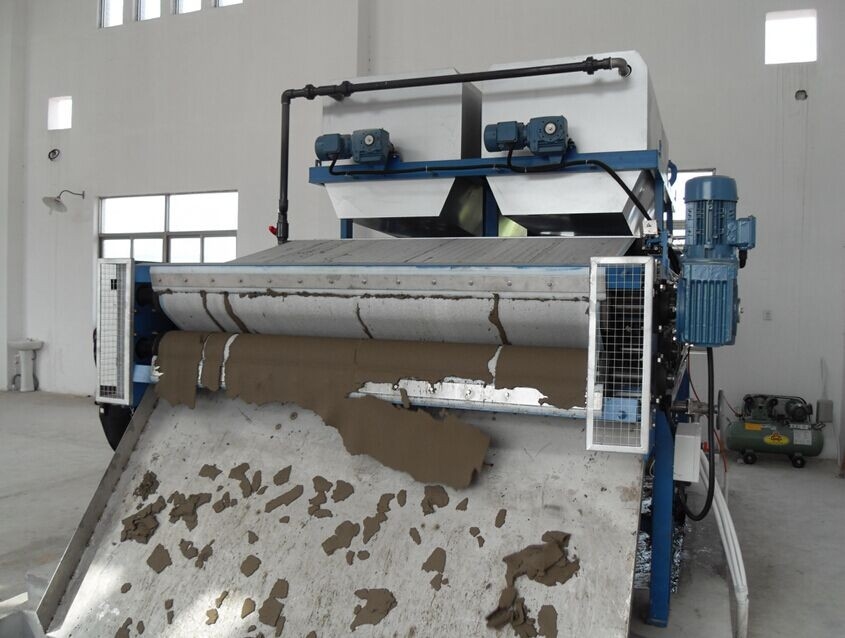
Once conditioned sludge enters the press, it passes through three distinct zones, each contributing to the progressive extraction of moisture.
In the gravity drainage zone, water drains freely through the lower filter belt under its own weight. No mechanical pressure is applied at this stage; the sludge simply sits on the belt and drains. Well-conditioned sludge can lose a significant proportion of its total water content here before it reaches the compression stages, which is why conditioning quality has such a direct bearing on overall dewatering efficiency.
From the gravity zone, the sludge moves into the wedge zone, where the upper and lower filter belts begin to converge. Pressure builds gradually rather than suddenly, which is important abrupt compression forces poorly conditioned or inadequately drained sludge laterally out of the belt edges rather than through them. The wedge zone prepares the material for the more intensive pressure that follows.
The pressure zone is where the primary mechanical work is done. The two belts pass over a series of rollers of decreasing diameter, and as each roller is smaller than the last, the effective pressure on the sludge between the belts increases. By the time the material reaches the final rollers, a substantial proportion of the remaining moisture has been extracted. The dry solid cake discharges at the end of the belt run, while high-pressure spray nozzles continuously clean the belts to prevent blinding and maintain drainage performance.
Operating Variables and Their Impact:
Belt speed is the variable operators adjust most frequently. Slower speeds mean longer residence time in both the gravity and pressure zones, which generally produces drier cake. Faster speeds increase throughput at the expense of dryness. The right setting depends on what the downstream process can accommodate and what the sludge characteristics demand.
Belt tension controls how much pressure is applied in the roller section. Higher tension extracts more moisture but accelerates belt wear and increases mechanical load on the rollers and frame. Lower tension reduces wear but may compromise cake dryness. Both settings need to be matched to the specific sludge being processed, not simply optimised in isolation.
Belt selection itself is a technical decision that affects long-term performance significantly. A belt that is too open allows fine solids to pass into the filtrate. One that is too tight restricts drainage. Chemical compatibility with the process stream particularly relevant in food processing and chemical applications must also be confirmed at the selection stage.
Industrial Applications:
Belt filter presses are used wherever continuous, high-volume dewatering is required. Municipal wastewater treatment plants use them to process primary and secondary sludges, producing cake suitable for agricultural spreading or landfill at substantially lower cost than wet sludge disposal. Mining operations recover process water from mineral tailings and reduce containment volumes. Food and beverage facilities handle brewery waste, vegetable processing effluent, and dairy by-products. Chemical processing applications require careful attention to materials compatibility throughout the machine.
A quality Dewatering Filter Press sourced from a reputable supplier, maintained according to the manufacturer’s schedule, and operated with proper attention to conditioning and belt management will remain productive for well over a decade making it one of the more durable and cost-effective investments available in industrial sludge management.